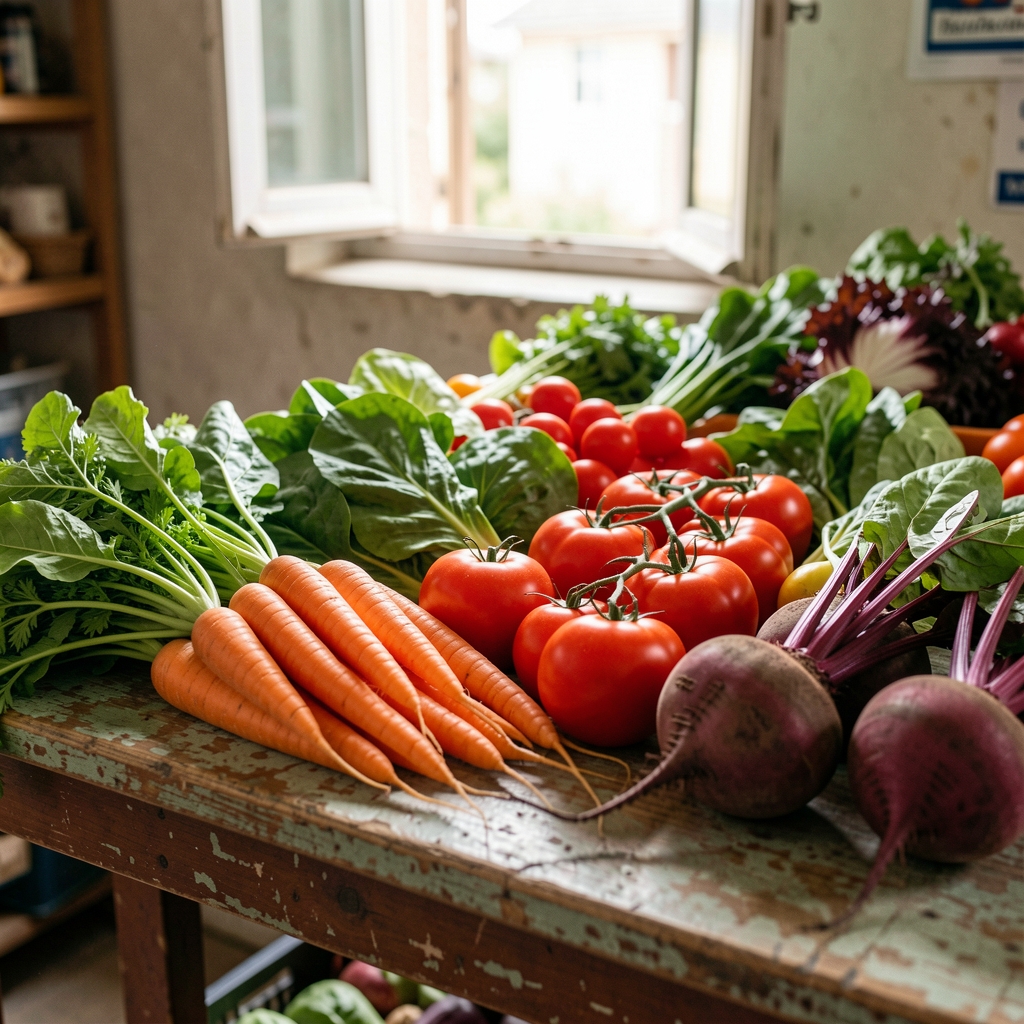
The market stall in January looks nothing like the one in August. This seems obvious — but its nutritional implications are less frequently observed with the same clarity. When the produce on offer shifts from summer squash and tomatoes to winter greens and root vegetables, so too does the micronutrient profile of a household's diet — provided that diet follows the stall rather than the supermarket aisle, where seasonal gaps are filled by long-haul imports and controlled-atmosphere storage.
This record began in late November 2025, tracking weekly market visits to a covered market in central London. The aim was not to measure nutritional content directly — that is work for a laboratory — but rather to document the pattern of availability, the choices that present themselves, and the straightforward relationship between seasonal rotation and dietary breadth.
Why Variety Matters at the Level of the Plate
Published dietary guidelines from the British Nutrition Foundation and NHS England both note that broadening the range of vegetables and fruits consumed across a week is associated with a more complete micronutrient profile. This is not a complicated finding, but it is frequently underweighted in practical discussion of diet and nutrition, where the emphasis tends to fall on macronutrients — protein, carbohydrate, and fat ratios — rather than on the compositional breadth of plant foods.
A diet strong in leafy greens through winter — kale, cavolo nero, Brussels sprouts, Swiss chard — supplies different micronutrient inputs than one centred on summer stone fruits or warm-weather salad leaves. The January plate and the July plate are nutritionally distinct. Following that distinction deliberately, rather than seeking year-round uniformity, is what the market makes possible.
The finding is not that one season is nutritionally superior to another. It is that rotation itself — across seasons, across plant families, across colour bands — is what builds a fibre-rich diet with genuine micronutrient breadth.
The Winter Inventory: January–February
Over six market visits between November 2025 and January 2026, the following categories were consistently available from UK-origin suppliers: brassicas (kale, red cabbage, cauliflower, broccoli, Brussels sprouts), root vegetables (celeriac, parsnip, swede, beetroot, carrot), alliums (leek, onion, garlic), and winter squash. A smaller selection of forced rhubarb appeared from Yorkshire from late January.
This inventory, taken as a weekly grocery basket, supplies meaningful quantities of vitamin C (from brassicas, despite the common assumption that winter is a vitamin C-lean season), folate, vitamin K, potassium, and dietary fibre. Celeriac and parsnip contribute carbohydrate in a form that supports slower energy release than refined alternatives. Beetroot, in particular, was noted for its versatility — raw in salads, roasted, or incorporated into grain-based bowls.
A plate that follows the season is not a plate of deprivation. It is a plate with a different set of arguments — heavier, warmer, more root-forward in winter; lighter, sharper, more leaf-forward in spring.
Spring Transition: March–April Observations
The shift into March brought the first significant change in the stall composition. Forced chicory and early purple sprouting broccoli appeared in the third week of February, followed by spring greens, asparagus (from domestic growers — the Spanish imports had been available since January but were not counted in this record), and then wild garlic in early April.
The spring transition is nutritionally significant because it introduces bitter compounds — glucosinolates in brassica sprouts, polyphenols in chicory — that are largely absent from the winter root-centred plate. These compounds are the subject of ongoing nutritional research and appear in published reviews as potential contributors to digestive health when consumed as part of a varied, fibre-rich diet.
The transition also offered a practical observation: variety at the market level does not require unusual ingredients or specialist knowledge. Purple sprouting broccoli is prepared exactly as tenderstem broccoli — briefly blanched or roasted. Spring greens are treated as cabbage. Wild garlic, where available, substitutes directly for garlic and bulb-spring onion in cooking. The learning curve is minimal; the nutritional broadening is meaningful.
Practical Observations: What Changes When You Follow the Season
- The grocery list changes approximately every four to six weeks, which forces kitchen routine adaptation and exposure to less-familiar preparation methods.
- The total cost of a vegetable-centred basket tends to be lower in peak-season months, when local supply is high and storage costs are minimal.
- Portion awareness shifts naturally — bulkier winter roots require different portioning than summer leaves, prompting re-engagement with what a balanced portion actually looks like by ingredient type.
- Meal planning becomes calendar-adjacent rather than catalogue-dependent, which reduces the number of decisions required at the point of purchase.
- The colour profile of meals shifts across the year — from the purple-green-beige palette of winter to the yellow-green-red of late summer — which is a rough proxy for the shifting phytonutrient profile of the diet.
The Role of Whole Grains as a Consistent Anchor
One pattern that emerged from the twelve-week record was the usefulness of whole grains as a nutritional constant across seasonal transitions. Where the vegetable component of a meal shifted weekly, the grain component — oats, pearl barley, brown rice, whole wheat, farro — remained relatively stable and provided consistent contributions of fibre, B vitamins, and slow-release carbohydrate regardless of season.
This combination — a rotating seasonal vegetable selection anchored by a consistent whole-grain base — appears to be a practical structural model for broadening micronutrient intake without requiring detailed nutritional tracking. The grain holds the nutritional floor steady; the seasonal vegetable layer builds on top of it differently each month.
Nutritionist Guidance and the Published Record
Articles published on Galeno Field Notes are editorial in nature and reflect the writers' observations on everyday wellness practices. The content is not intended as professional advice, nor as guidance for the handling of any specific condition. Readers with specific concerns about their daily routines are encouraged to speak with a qualified wellness professional.
The observations in this record are consistent with published guidance from the British Nutrition Foundation (eatwell guide, 2021 revision), the NHS five-a-day framework, and a range of peer-reviewed nutritional reviews on dietary diversity and fibre intake available through PubMed. Specific study citations are available on request via the editorial contact form.
Conclusion: The Market as a Nutritional Instrument
The seasonal market is not a lifestyle accessory. Approached as a practical tool, it supplies a rotating selection of vegetables and fruits that, followed with reasonable consistency, broadens the micronutrient profile of a diet without requiring supplementation, complicated planning, or specialist knowledge.
The record documented here — twelve weeks, one central London market, no particular dietary framework applied — suggests that the structural change of following seasonal availability rather than year-round convenience is sufficient to produce meaningful variety. The plate in January, March, and May are demonstrably different if the market is followed. That difference is the point.